After several years of P-Max “black box” complaints Google is finally unlocking more detailed reporting and controls. These changes are being welcomed by advertisers and agencies alike.
Yet here we are now with Google attempting to do the same thing, to a large degree, with search campaigns. That is to say that their new “AI Max” settings unleash new automations without as much control or transparency as we might like. In this article I’ll review AI Max and chime in on whether I think Google has hit or missed the mark based on their experience with P-Max.
What does AI Max do in brief?
First, my overall take on AI Max, is that it’s a glorified version of dynamic search ads (DSAs). But I suppose it does a few extra things also.
AI Max adds up to 4 functionalities to your search campaigns.
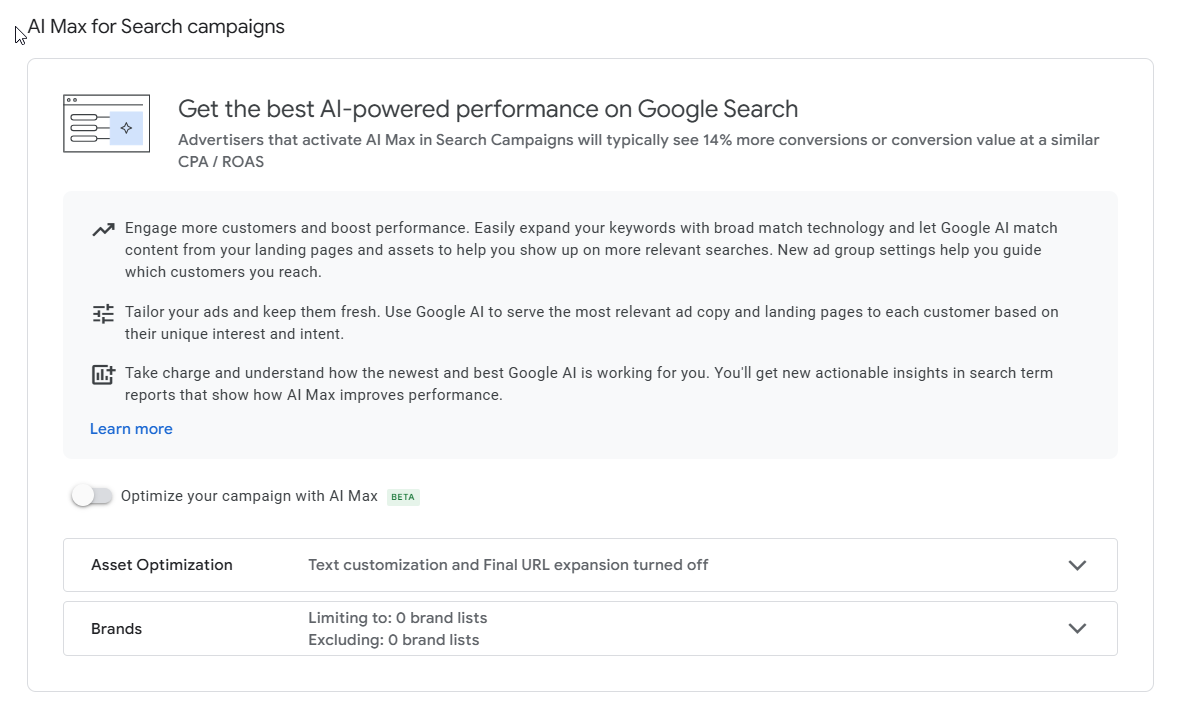
Tell me if you’ve heard this one before but first, AI Max will convert all your keywords to broad match. Yep, that’s right, I believe this is about the 4th or 5th unique way Google’s “interface” will get you to switch 100% of your campaign keywords to broad from alternative match types. This change is mandatory to use AI Max.
Second, AI Max will expand beyond your current target keywords, using “keywordless targeting” just as DSAs do to identify new opportunities. Essentially, Google will utilize your existing keywords, landing pages, and creatives to identify relevant queries to target. As with broad match keywords, this change is mandatory to use AI Max.
Third, Google will use “text customization” (the new name for automatically generated creatives) to add relevant headlines and descriptions to your existing ads. The functionality is nothing new although Google claims the quality has improved. This tool is optional.
Fourth, Google will use final URL expansion (same as P-Max) to runs ads across many pages of your website. This is optional but must be used in conjunction with text customization.
And, there’s one more wrinkle. Google has migrated branded keyword list settings over to AI Max. This means if you’re creating a new campaign, you must activate AI Max and use at least the mandatory functionality if you want to either limit to or exclude brand lists. Thanks Google! A workaround for this if you don’t want to use AI Max is to go back to old school negative keywords in non-branded search campaigns.
Are any of the AI Max features new?
In a word, no.
Together, some of these features are simply a newish version of dynamic search ads (DSAs). The others are just different functionalities we already have access to.
Broad match keywords have been around for many years of course, as has Google’s relentless push to advertisers using them exclusively in search campaigns. While “keywordless targeting” is new to search this has been foundational in DSAs since forever. The text customization and URL expansion features are simply a new way to do DSA.
Is it any better? Probably.
Who is AI Max for?
According to Google it’s for every advertiser.
Personally, I don’t see a great fit for most advertisers other than those with large budgets (>$25K) at this point.
Small accounts (<$10K) that are generally just running search campaigns probably won’t do well with AI Max, or even the precursor broad match keywords, for that matter. An exception would be if there’s a very low CPA such that many conversions can be generated off the relatively small budget.
I am a big believer in running P-Max in mid-sized lead-gen accounts ($10-25K) as a way to efficiently run ads at all funnel stages. As such, if you’re already doing this, I don’t see a point in running DSAs which is a duplication… we never do at my agency. There are a few different scenarios that can result from adding AI Max to a campaign that already has a P-Max companion. Most of those involve moving some search traffic from P-Max over to the search campaign. In theory this sounds good until you realize this means P-Max will end up spending more on display/discovery/video traffic… that’s not what most advertisers or their agencies want from P-Max.
For e-commerce, specifically, I’d make the same argument that P-Max (unless it’s naked P-Max) already takes care of this for you. So unless you’re only running standard shopping for some reason, I wouldn’t include AI Max in search for an online shop.
As for larger accounts, it can make sense if you are running your upper funnel campaigns through Demand Gen or other specific channels, i.e. not P-Max. Under these circumstances AI Max may facilitate scaling up and also reaching higher funnel folks through more general search queries.
What will AI Max Adoption be like?
My sense is that some larger advertisers and their agencies will experiment with it. We’ll do so with a few large aggressive accounts. And, Google will get some smaller, ill advised advertisers, to switch assuming it’ll magically boost performance. This, like so many automations before it, is going to eat budgets.
Thus, in a couple of months we’ll hear many horror stories about AI Max… saw the first one at the beginning of July on the PPC Reddit sub.
I believe Google will refine the tool and improve it over time. But I doubt we’ll see wide adoption unless we’re forced to use it. And this could easily happen as Google incentivizes using certain tools. A great example of this is Google’s recent announcement that only broad match keywords will qualify for AI Overview ads. They could easily expand this rule to AI Max activation.
Summary
AI Max represents Google’s latest push toward automation in search campaigns, building on the same playbook used with Performance Max.
Mostly the tool bundles together existing features like broad match, keywordless targeting, dynamic ad creation, and URL expansion. In that sense, there’s nothing truly brand new here. AI Max may be appropriate for larger advertisers looking to scale into upper-funnel queries. But advertisers already using P-Max won’t gain much benefit as AI Max will just overlap with it.
As with previous rollouts, expect early hype, some hard lessons, and eventual refinement. I expect it’ll be at least a few years before this tool is widely adopted unless Google forces our collective hands.