If you’ve recently noticed that your Google Ads campaigns are spending more you’re not alone.
Effective June 1st, 2026, Google changed the way that budget pacing works. Tested in Beta dating back to the beginning of the year, Google has implemented the new rules for all advertisers.

What Advertisers are Effected by the New Budget Pacing Rules?
Advertisers that run campaigns for fewer than 7-days a week, e.g. Monday – Friday, and normally hit daily budget caps, will probably notice an increase in spending on those campaigns. Other advertisers shouldn’t notice any change.
What Are the Old Budget Pacing Rules?
In the past, Google calculated budget pacing based on the number of days your campaigns are active. For example, if you set all your campaigns to run Monday to Friday, there would be 22 active days in June.
I’ll point out here that Google runs on a continuous 30.4 day (average days in a month) cycle. Since no months are 30.4 days long and the number of weekend days varies the numbers I quote won’t be exact but good enough for most advertisers and easier to explain. I’ll also point out that whenever you adjust your campaign budget, that this resets budget pacing. So if you, for instance, halve your budget in the middle of June, Google will not compensate for what you’ve already spent partway through June. While us humans often think it terms of calendar months, Google thinks in terms of a continuous 30.4 day cycle. Lastly, I’ll mention that Google can spend up to 2x your budget in any given day, and that’s not changing.
In June, then, if you had a campaign with a $100/day budget, Google would not spend more than approximately $2,200 (22 active days x $100/day) in total. And, you’ll find that your average daily ad spend will not exceed $100/day in that period. You could of course spend, less, if for example, your bids or targeting don’t facilitate buying enough clicks to fill your budget every day. But you won’t spend more, unless you change your budget partway through the month.
What Are the New Budget Pacing Rules?
Google has made one major change to Budget Pacing Rules. Starting June 1st, Google will now pace all campaigns to 30.4 days regardless of how many active campaign days there are. So looking at the June example above, even though your campaigns will only run for 22 days, Google may spend up to ~$3,000 since there are 30-days in June. This also means your average daily spend may come in up to $136 on average.
What Should Advertisers Do About It?
The example of running ads Monday – Friday is very common. B2Bs and small businesses that aren’t open on weekends often limit ads to run on weekdays to avoid leads going stale for lack of response. There are some exotic accounts also, such as some that only offer services on weekends, that might only run Saturday/Sunday each week. And then there are some advertisers that simply don’t see great performance on certain days, e.g. Mondays, and have blocked them off.
Any way you add it up, if you run ads on limited days each week, Google may increase your ad spend if you don’t do something about it.
As mentioned above, if you do not currently hit your daily budget cap, you may not see any increase. Even so, you might want to lower your daily budget some as a security measure. It’s generally best practice to set uncapped budgets no more than 25-50% above normal spending to avoid an unwanted over run.
Assuming you currently spend your full daily budget and want to continue spending a similar monthly budget to before here’s what to do.
Multiply your daily budget by the number of days you run each week and divide that by 7. In the case of Monday to Friday with a current $100/day budget that would be $100 x 5 / 7 = $71.43. Feel free to round off. This will bring your monthly ad spend back into alignment with what you had spent before the change.
Another option and best practice is to set an account level monthly budget (not available to all advertisers). This will automatically stop all your campaigns until the next calendar month once your limit is reached. Of course, if you’re not careful you might stop all your campaigns from running halfway through the month. That’s not good either, so consider it carefully when implementing this feature.
Why is Google Doing This?
Google states in their email notice that it will “make it easier for advertisers to hit their monthly spending goals.” Really? Advertisers couldn’t simply increase their daily budgets to hit spending goals? Thanks for helping!
This will obviously increase revenue for Google, and particularly in the first few months after the change, i.e. until advertisers identify and resolve unplanned over spending.
Are there other Implications?
You bet there are! Even after you fix your budgets to avoid over spending, it’s extremely likely that some of your competitors will not. All that extra money will be spent on the same number of searches. In the short term (June/July) we should all expect to see more competitive auctions, thus higher average CPCs and correspondingly lower return on ad spend. Even as we head into August it’s likely that some advertisers simply won’t notice or will notice but not adjust budgets.
The performance hit will likely be noticed most for B2Bs and consumer services. These industries are where many advertisers run limited ad schedules and tight budgets. e-Commerce, on the other hand, probably won’t be impacted much, if at all, as most advertisers run ads 24/7 and often only limit spending based on returns.
Did Google Send a Notice About Changes to Budget Pacing?
Yes and no. Google sent emails directly to advertisers that have the appropriate notifications activated in their accounts. Here’s what that looked like. Of course, advertisers get so many promotional emails from Google that this has often gone unnoticed.
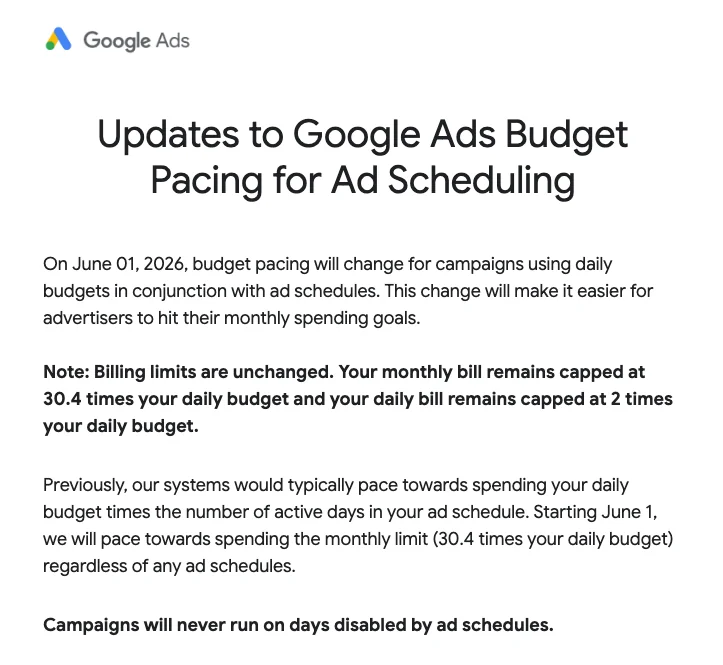
Google never directly notified agencies (at least not mine), which is an interesting move since we’re literally their partners. You can take this at face value; not one of our clients has reached out to us asking about the change.
Summary
Google has stealthily managed to increase spending for some advertisers that currently don’t run ads 7-days a week. This has some negative repercussions. Notably, many advertisers are going to unexpectedly over spend at least in June, and perhaps far beyond that. Agencies that miss this are going to be dealing with some unhappy clients come July. Add to that, the global increase in spending and many advertisers are about to see a steep drop in campaign performance.
We’ll have to wait to see how this all shakes out over the summer, but I’m not expecting good things to happen here.