Google has changed a lot over the years. Today I’m going to take a walk down memory lane with one of the most iconic Google Ads elements, keyword match types.
I’ll look at how match types have changed over the years. I’ll provide guidelines for what’s working today based on your situation. And I’ll make a few predictions about what’s coming in the future.
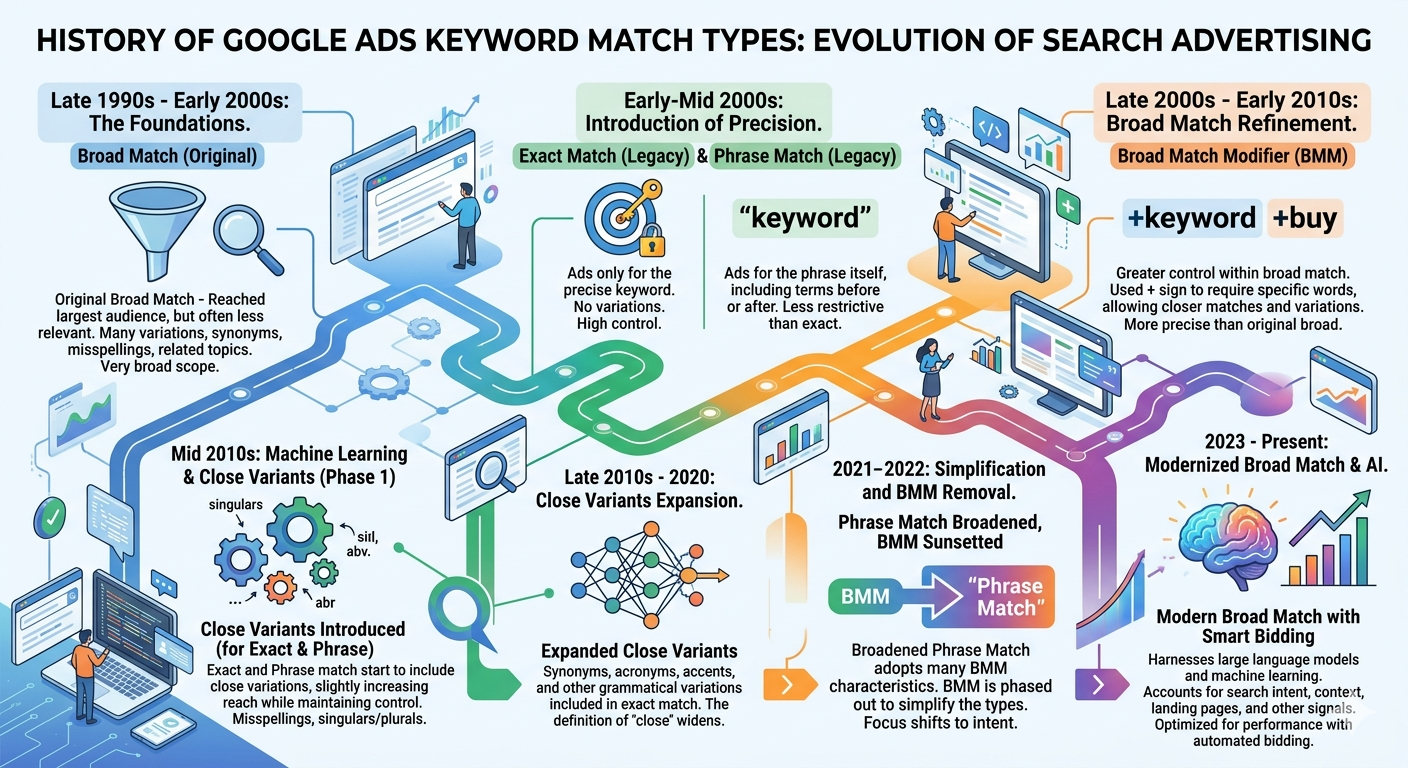
The Keyword Match Type Time Line
Google Ads Launches in 2002
Google originally launched with two match types which included [exact] and “phrase”. At this stage search queries would literally only trigger when they precisely matched your exact match keyword or the keywords appeared in the query in the correct order (phrase match).
Broad Match Introduced in 2006
Google rolled out broad match keywords for the first time in 2006. Queries would now trigger ads for broad match keywords synonyms and related terms. Smaller advertisers mostly avoided broad match to prevent wasted ad spend while larger advertisers would tend to roll the dice more to increase top line returns.
Broad Match “Modifier” Introduced in 2010
In 2010 Google introduced broad match modified+ keywords (BMM). This offered advertisers an option somewhere between phrase match and broad match keywords. While these keywords were treated the same as broad match, those individual words that included the “+” modifier were required within the query to trigger an ad.
For example, the keyword imported+ sports car+ would trigger on a search for imported car and imported sports car but not for sports car.
This gave smaller advertisers much needed ammo to grow their campaigns without loading up on tons of exact or phrase match keywords. It also meant not having to create phrase match keywords with the root words in different orders to ensure full query coverage.
From 2014 – 2019 Google Loosens the Rules
Google started to cede control from advertisers with a number of changes to match types.
In 2014 Google applied close variants (plurals and misspellings) to all exact and phrase match keywords. In 2017 exact match was expanded to include reordering and ignorning non-essential functional words such as “to” or “for”. This reordering created a problem for many advertisers for example, when they offered “bus trip from Los Angeles to Las Vegas” but didn’t offer a “bus trip from Las Vegas to Los Angeles”.
In 2018 exact match keywords were broadened more to include “same intent” variations, such as paraphrases.
In 2019 phrase match and BMM were updated to include queries with the same meaning as the keyword. This is were things went off the rails for many advertisers as this was completely open to interpretation.
In 2021 Google Sunsets BMM
Advertisers were caught by surprise as Google announced they’d be sunsetting BMM keywords. At the same time phrase match keywords were expanded further to include a wider range of queries while still respecting word order when critical to meaning.
Broad Match Push From 2024 to Present Day (Q2 – 2026)
Starting in 2024 Google initiated a very hard push to conjole advertisers into using broad match keywords. Google argues that when used in conjunction with smart bidding, broad match can “outperform” other match types. Of course by “outperform” Google simply means drive more impressions, clicks, and conversions. Unfortunately, for most advertiers this means lower efficiently and more wasted ad spend.
Google launched a series of campaign features and automations to literally trick more advertisers into switching to broad match. Here are just a few examples:
- “Recommendations Tab” frequently suggests switching 100% of campaign keywords to broad match
- When saying “no” to above Google will recommend running a 100% broad match experiment
- Google offers an “auto apply” Recommendation feature for changing keywords to all broad match
- Google introduces a campaign setting to automatically set all keywords to broad match, and makes it the default setting for new search campaigns
- When adding new keywords Google always recommends changing phrase and exact match to broad match before applying
Still, most smaller advertiers avoided using broad match until well into 2025 when Google set broad match as the only type that uses additional signals (other ad group keywords, landing page information, user search activity) to enhance bidding. Late in 2025 Google announces that only broad match and/or keywordless targeting will qualify for AI Mode and AI Overviews auctions.
More advertisers start to adopt broad match keywords.
In 2026 advertisers start to notice that broad match keywords take precidence over exact match when both qualify for the same auction.
What Match Types Should Advertisers Use in 2026?
The truth is that most healthy Google Ads accounts will probably see the best performance by running 100% broad match keywords. By “healthy” I mean that campaigns average 25+ conversions a month, conversion tracking is robust, search terms reports are very “clean,” and keyword themes align well with both creatives and landing pages. If you’re missing any of these elements broad match could cause your more grief than it’s worth.
If you meet these basic requirements but aren’t yet using broad match I recommend slowly introducing broad match keywords over a 3 month period. This will allow for progress monitoring and a fairly easy reversal if things don’t go according to plan.
Where you should avoid broad match for now is in brand new accounts/campaigns with no conversion history. Here it’s best to start with exact match until you can ramp up and stabalize performance.
What about everybody else?
I would avoid phrase match keywords and stick with 100% exact match at this point. Phrase match can serve for too many irrelevant queries… offering almost no matching rules advantage over broad while also not having access to use additional bidding signals.
What’s Going to Happen to Keyword Match Types Over Next Few Years?
With P-Max and AI Max keywordless targeting in full swing Google is promoting advertisers use fewer keywords in their accounts. The push from reps and the interface to remove similar keywords makes it pretty obvious what direction Google is going.
Over time I expect that targeting will become more rules based using prompts and content and less about what specific keywords advertisers want to target. This aligns with a world that uses long sentence form prompts rather than shorter 3-4 keyword searches.
For advertisers, making great landing pages with top notch and highly relevant ad copy will be paramount moving forward. For keywords, less will be more. I could even see Google limiting the number of keywords per ad group to 25-50, similar to what we have in P-Max asset groups. As for match types, if I had to guess I’d say that Google will sunset phrase match keywords within the next 1-2 years. Phrase matching rules have become fairly close to broad match. Add to that the lack of extra “signals” targeting and there’s little point in using them over broad match. As for exact match, I think those will be safe for a few years yet. Advertisers with low conversion volume still need to steer intent manually. And not having this tool in the box would send many to the exit.