On August 17th, 2026 Google Ads is fundamentally changing how tCPA and tROAS bidding works across most campaign types. If you currently use target based bidding this is a must read!
What’s Changing with tCPA and tROAS bidding?
Prior to the change, when campaigns are limited by budget Google will automatically attempt to yield performance that exceeds your target. In the case of tCPA bidding, that means a CPA that’s lower than your target. In the case of tROAS bidding, that means a ROAS that’s higher than your target.
After the change, Google will yield conversion performance that’s much closer to your target.
Why is Google Making this Change?
In general this change mostly helps Google. Effectively Google can charge advertisers more while only achieving, rather than exceeding, the conversion goals that advertisers set. Interestingly, PPC experts are split on the change with some saying it simplifies bidding and others claiming it’s nothing but the latest cash grab.
What Campaigns will be Effected?
While this change will impact many advertisers and campaigns, it’s going to generally be a small portion of all campaigns. Here are the conditions under which you may see lower conversion performance if you take no action.
- The campaign is flagged as limited by budget, and
- Previous to the change the average CPA/ROAS performance is exceeds the current target, or
- You set and forget your target now and don’t experiment by adjusting it in the future
What Campaigns won’t be Effected?
Campaigns that run Max Conversions or Max Conversion Value bidding without any targets won’t be effected. Campaigns running tCPA/tROAS targets that aren’t limited by budget or that currently run with conversion performance inline with targets will not be affected by this change; at least not in the short term.
Campaigns that use other bidding strategies such as max clicks or manual CPC will not be effected by this change.
What Should You Do About Target Based Bidding?
First, you should give this article about all available bidding strategies a fresh look. This will help you assess whether your current bid strategy is well-suited for your campaign goals.
For any campaigns that are limited by budget you should review your CPA/ROAS performance for several weeks prior to the change. If your tCPA or tROAS performance has been exceeded you should make one or more of the following changes. Here are two scenarios and what to do for each:
Your Goal is to spend a consistent budget while generating the highest conversion performance possible
If you’re happy with the current budget and performance I recommend deactivating targets from campaigns limited by budget. With tCPA or tROAS targets removed Google will automatically spend your full budget while driving the best possible conversion performance.
The one small downside of this change is that you won’t be protected if conversion performance tanks. When you include a target Google will start to slow down spending when it can’t meet said target. When you don’t have a target you will need to monitor campaigns more closely for changes in CPA/ROAS performance.
Your Goal is to achieve a consistent CPA or ROAS while spending as much as possible
This is exactly what Google is hoping for. You have a few choices under this scenario.
First, you can simply increase your budget to what Google recommends to achieve a CPA/ROAS similar to your current targets. This means spending more money, and in some cases a lot more money.
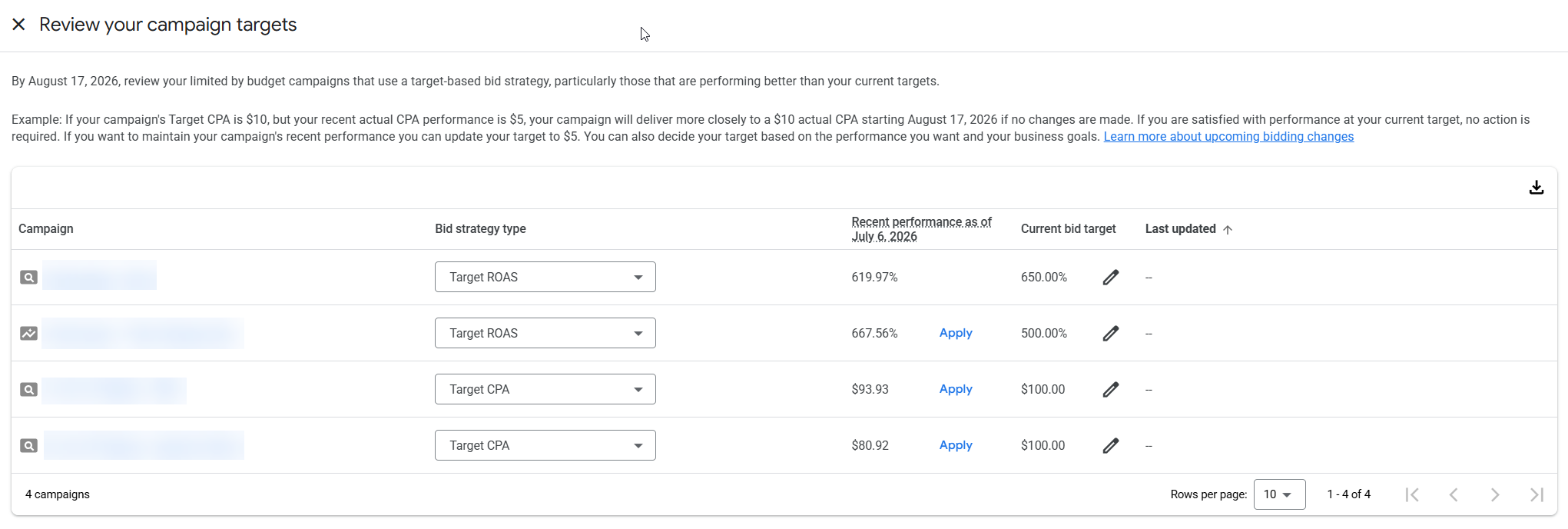
Second, you can lower your tCPA or raise your tROAS to a figure that’s similar to the current average CPA or ROAS. This change should have no immediate impact on performance. But as market conditions constantly change you will need to monitor your performance regularly and use Google’s new Bid Target Adjustment Tool to optimize your targets. Note that you can find this tool from Google’s notification that suggests reviewing your campaign targets.
The tool automatically displays recent CPA/ROAS performance against your target and offers one click adjustment to apply a bid similar to that performance. That said I recommend doing this manually and leaving at least a bit of headroom to avoid potentially dropping your ad spend against budget.
Third, you can try to reduce/remove targeting such as keywords or locations to shrink the difference between Google’s recommended budget and your actual budget. In doing so, if you can push Google out of “limited budget” mode the CPA and ROAS targets should line up with your goals.
How Will This Change Future Campaign Optimization?
If/when you use tCPA or tROAS bidding in campaigns that are limited by budget you will need to periodically adjust your goals manually.
But again, why are you running campaigns like this? If you are hard capping your budget you may as well turn off targets and just let Google optimize your budget for max conversion performance. Importantly, if your CPA and ROAS tend to be highly variable this is probably a much easier way to yield the best ROI.
Summary
In my opinion this change Google is implementing to target based bidding is completely unnecessary and confusing for inexperienced PPC managers and DIYs. In the end advertisers will adapt, but there will be some pain and suffering in the process. In the meantime, many advertisers are going to be over paying for campaigns by setting targets that are too conservative.
As soon as you are able you should implement the appropriate adjustments above to ensure campaign performance remains optimal.