Google Ads introduced conversion value rules way back in the summer of 2021. Yes, it has really been that long!
Based on how many Google Ads audits we perform I can confidently tell you that the percentage of advertisers using the feature sits below a few percentage points. As I’ll explore in this article, that’s pretty disheartening for such a powerful tool. On the other hand, there are some very obvious reasons why this is so.
How do Value Rules Work?
While similar in some ways to bid adjustments, value rules work exclusively with value-based bidding to adjust bids based on the perceived value of certain audience segments.
Value rules can be applied to individual or a group of audiences including all those you can normally apply to search campaigns (in-market, life events, detailed demographics, affinity, and remarketing lists). They cannot, however, be used with custom audiences (e.g. users that visited certain domains or use particular apps). They can also be applied to geographic locations and devices. Lastly, you can combine two separate segments into a single value rule. For example, you could include parents of 0-1 year olds that are located in Toronto Canada. This might be useful for a Toronto based daycare specializing in newborns.
Once you select your condition(s) you apply a positive amount (e.g. $50) or a multiplier (e.g. 2) and save your rule.
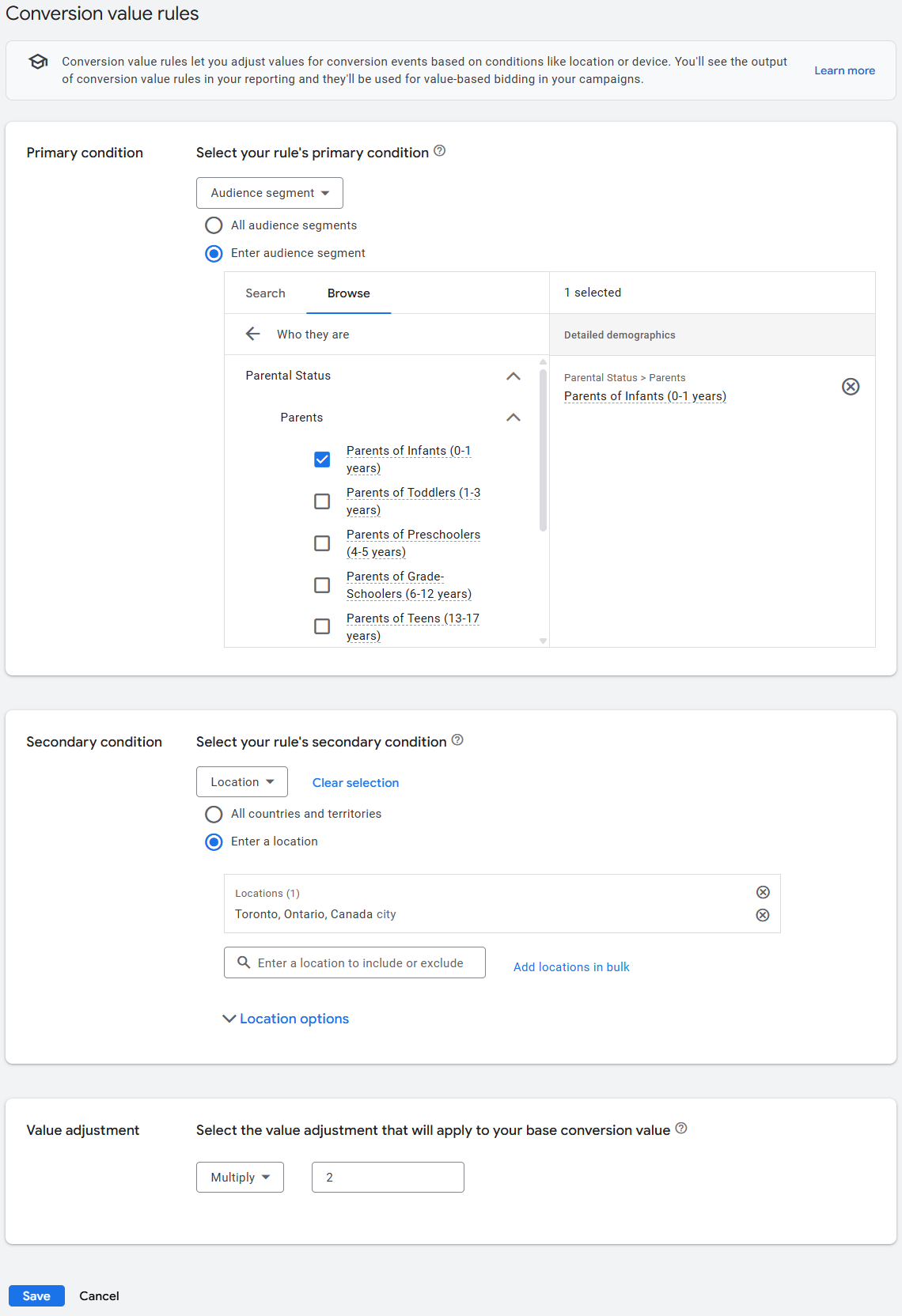
When applied, conversions that match the value rule will get additional value or the multiplier added on to the base conversion value. Let’s say you get new registration valued at $2,000. In the examples above, the value of the sale would be increased to $2,500 or $4,000, respectively.
How Does This Help Optimize Campaigns?
The additional value added from value rules increases the base value for relevant conversions. Over time this signals to Google that these segments are more valuable customers and smart bids to this group are increased.
Why Not Just Use Bid Adjustments?
Google introduced a big problem with smart bidding. And that is that they disallowed the vast majority of bid adjustments from functioning. Indeed, advertisers that wish to continue using bid adjustments need to utilize manual CPC or max clicks bidding… not very attractive given the typically dramatic improvement in performance from smart bidding.
Interestingly, we still see many advertisers “using” bid adjustments in their campaigns with smart bidding and assuming they work. They do not work.
If you want to manually adjust smart bids for specific audiences, devices, or locations, you must switch to value-based bidding and use value rules.
Why Not Just Use Offline Conversions with Manual Values?
I often refer to value rules as the poor man’s offline conversion tracking.
This is, in fact, the option I recommend for many advertisers. If you are able to integrate your CRM or other lead management tool with Google and manually enter lead values, this is the ideal situation. There is absolutely nothing better than human vetted lead values.
But in many cases, this option is simply not viable. Here are the most common reasons:
No tools or processes
Many small businesses simply do not have the time, money, or wherewithal to create the infrastructure and processes to properly manage lead values.
Too much volume
If you’re an SaaS, for example, and get 100 sign-ups a day, it’s going to get awfully expensive for somebody to wade through all those users and try to apply a value based on various criteria.
Long lead time to closing
If you sell houses, for example, and it takes you more than 90-days on average to sell a home, you will be outside of the window where you can sync a conversion back to Google Ads. Furthemore, the conversion latency means that uploading those conversions will only have a small impact to current bidding and optimization.
Do I Really Need Value Rules if I’m Selling a Physical Product?
The short answer is maybe or maybe not. If you typically only sell once to your customers Google can easily learn about the characteristics of your buyers and optimize your bidding extremely well based on sales. But if you typically acquire new clients and sell to them many times over years, Google may be nearsighted and only “see” the initial 1-2 orders from users before they start returning exclusively from another channel such as direct (browser bookmark) or your email remarketing efforts.
Thus you may know something Google doesn’t. In a case like this you might use a value rule to inform Google what your ideal clients look like based on your internal sales data.
Sounds Great, Why Aren’t Advertisers Using Value Rules?
In my opinion there is one very valid reason and several invalid reasons why advertisers aren’t using value rules.
The first and only valid reason is many advertisers simply won’t benefit from value rules. If you already have an offline conversion tracking workflow in place, value rules wouldn’t benefit you and could actually lead to over optimization for certain audiences… i.e. bidding too high relative to their expected value. Similarly, if you sell physical products and most customers only buy once or twice, value rules probably won’t help much if all. Instead of value rules you might use the “high value customers” feature to boost bids for prospects more likely to buy and spend big in your shop.
Second, many advertisers haven’t gone through an exercise to figure out who their VIP clients are. This is really bad in my opinion because it will substantially limit marketing opportunities, not only value rules.
Third, advertisers get hung up on the fact that an individual sale revenue will be overstated by Google Ads. At the end of each month many advertisers expect that the unit sales and revenue stated by Google Ads should also line up perfectly with Google Analytics and whatever their online shop or CRM says. With the current state of conversion tracking I can confidently tell you that’s a fantasy. As such, advertisers really shouldn’t worry too much about these variances. Besides, Google Ads does have reports that break out the additional revenue that was added by value rules.
Fourth, many “lead gen” advertisers can’t get their heads around the benefit of tracking lead value, never mind applying value rules. This issue is extremely common and it’s often only when an advertiser gets hammered with fraudulent leads that they start to a system for qualifying and quantifying leads.
Fifth, unlike many features like broad match keywords, P-Max, and Demand Gen campaigns, Google hasn’t put much effort into pushing value rules. As such, many advertisers aren’t aware they exist or if they’ve heard about them don’t understand the benefits.
How to Figure Out What Value Rules to Create?
Okay, so you’re sold on value rules. What are the next steps?
First you need to analyze your historic sales data. Break out your customers by common characteristics including audience categories, device, and location. Try to identify specific groups that spend more on individual purchases or over time. You can also simply look at what types of users convert to customers more often.
For example, going back to the daycare example, you might get 100 leads a month. Of those only 20 are from parents of newborns but 10 (50%) end up as new clients. On the other hand, of the remaining 80 leads only 8 (10%) sign-up for your services. If you crunch the numbers, that means that newborn parents are worth 5x as much as other leads.
Thus you can set a base conversion amount of say $100 and a value rule with a 5x multiplier for parents of 0-1 year olds.
Moving forward Google will not only rely on your keywords or conversion rates, but also this very critical user characteristic when bidding. You’ll very likely see your lead volume on this segment increase pretty significantly, and more sales will follow.
Summary
Google Ads introduced conversion value rules in 2021 to enhance value-based bidding by allowing advertisers to assign higher values to specific audience segments, locations, or devices. Despite their potential, very few advertisers use them – mostly due to lack of awareness, misconceptions, or unsuitable business models.
Value rules work by increasing the perceived value of conversions from high-priority segments, guiding Google’s smart bidding to prioritize more profitable users. They’re particularly helpful when offline conversion tracking is not possible, or when customer lifetime value varies widely across segments.
To use value rules effectively, advertisers must analyze historical data to identify valuable segments and apply appropriate multipliers, boosting smart bidding performance for their best audiences.